Southern Red Sea
The Brothers
The two tiny islands known as The Brothers lie approximately 67 kilometers east of Quesir seemingly in the middle of nowhere. Big Brother is 400 meters long and easily dwarfs Little Brother which is situated half a mile away. It is easy to become overwhelmed by the shark action here and forget to enjoy the island's amazing walls, which are covered in gigantic soft corals. There are two wrecks at Big Brother while shark sightings are guaranteed on Little Brother. Here greys, white tips, silver tips, hammerheads and threshers are all present when conditions are right and oceanic white tips are often seen circling the boat at night.
Big Brother is easily recognized by its lighthouse which was built by the British in 1880. It stands 31 meters high and is the only landmark on the barren rectangle-shaped island. The bleak appearance of the island itself is a stark contrast to the beauty underneath the water.
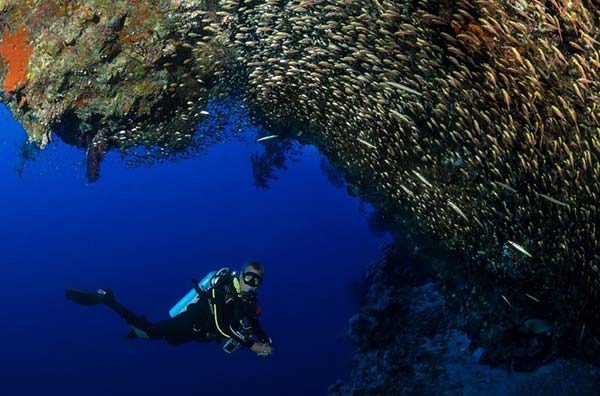
A fringing reef drops off on all sides with the exception of the North East side of the island. The sheer walls are covered in soft and hard corals along with huge sea fans. Among the many fish, millions of orange anthias dominate the surrounding scenes as they dash and dance in and out of the corals. There is a cave full of thousands of glassfish which is well worth exploring.
The Numidia lays on the north side of Big Brother. The wreck is covered in vividly coloured soft corals and is well preserved and in one piece apart from the top and mid sections. Halfway down the wreck at 40 meters the views are breathtaking looking upwards.
The Aida , an Egyptian troop carrier, sunk in 1957 in the process of securing its mooring. Its remains now lie scattered in a few meters of water where you can also find the engine. However, the main section which is still pretty much intact, rests between 30 – 60 meters.
Little Brother is a tiny round island and is ranked by many as one of the world's best dive sites. There are large plateaus on the north and south ends of the Island making the scenery very spread out. The walls are simply breath taking with soft corals, sea fans and fish everywhere! Fish usually range from millions of orange anithias to snappers, tuna barracuda and trigger fish. Whale sharks and manta rays can also be seen at certain times of the year.
Daedelus
This small, isolated Reef also known as Abu el-Kizan lies 96 kilometers off the coast of Marsa Alam, nearly halfway to Saudi Arabia. Daedelus Reef is almost round and reaches approximately 500 meters at the widest point. Another lighthouse built by the British in the 19th century stands in the middle of the island and is the only reference point for miles. Astonishingly, the lighthouse is still run by a small group of 4 who receive their supplies by boat once a month. Dived less often and more unspoiled, this place is our pick of all the Southern sites.
Its spectacular sheer walls are equally as good as the Brothers Islands, carpeted in soft corals, hard corals and enormous sea fans. The vertical walls drop away quite steeply on all sides with the exception of the South where we find a beautiful plateau instead which is between 30 and 40 meters. The East wall is exceptionally sheer with spectacular caves and overhangs where large groupers are frequently encountered. There are more exquisite corals to be found on the West wall including some predominant hard coral formations.
Expect to see barracuda, jacks, tuna, rainbow runners, grey reef sharks and hammerheads. Threshers and dolphins can also be seen on occasions as can mantas and whale sharks. A large field of beautiful anemones and clown fish easily ranks with Anemone City at Ras Mohamed. Turtles are sometimes seen and you can bump into the occasional grey reef sharks and resident thresher sharks. Some of the hard coral is awesome and the underwater scenery is just as spectacular as Little Brother.
Elphinstone is one of the most frequented dive sites in the Southern Red Sea. It's a long, narrow reef reaching approximately 300 meters in length. Elphinstone is located 12 kilometers out from Marsa Abu Dabab. Strong currents will take you on one of the most adrenaline charged drifts of your life along amazing sheer walls covered in soft corals and teaming with fish. This spectacular reef has walls that plunge down to 70 meters or more.
The place to get the real buzz is on the North plateau. You'll need motorized fins to reach it, but when you do you will find yourself surrounded by white tips, grey reefs or even hammerheads. On the south plateau there is a deep archway at 55m where thresher sharks can often be seen. Here lies a large coral encrusted rock which was once thought to be a sarcophagus.
Rocky Island lies just a few kilometers north of Sudan and offer very different diving.
Described as the most adrenaline pumping dive site in the Red Sea, the reef at Rocky Island is shaped almost like a kidney bean and is where many strange and familiar reef fish hang out.
The sheer walls, enclosed in soft corals, sponges, and sea fans, drop sharply from just a few meters below the surface and continue down to the first plateau at 25 meters, then again to 50 meters and more. Tall dangling sea whips sprout from deeper water, while several great caves and overhangs offer a great place to watch the sharks go by. There is a great deal of shark and pelagic action especially at the southeast corner of the island. The strong currents make for an exciting dive.
This peaceful marine park island is located just 5 1/2 kilometers from Rock Island and 46 kilometers southeast of Ras Banas. Zabargad is the largest island for miles around covering a triangle of 5 square kilometers. The ancient Pharaohs, Romans and recently, the Egyptians all mined 'olivine' (a green mineral) here on this island. Zabargad has good shelter and its beaches attract nesting turtles which are best seen in the month of August.
It is recognized by many to be the most beautiful island for diving with its extensive diversity of fish life ranging from tiny anthias to huge groupers. Morays, turtles and octopus are also seen here as well as numerous other underwater life. Zabargad boasts a fantastic turquoise lagoon and shallow coral reefs showing off dramatic colours at depths of 18-25 meters so the site is often used for night dives. Plenty of invertebrates, such as cuttlefish, squid, and octopus are most active at night when the site takes on an entirely different character.
Stretching out from the southern shore of Zabargad Island is a sandy slope totally covered with an astonishing concentration of coral pinnacles. Each 'fairytale castle' pinnacle creates a home for miniature reef fish which appear like big fluffy clouds around the intensely coloured coral. Larger reef fish can be seen cruising through the pinnacles. The sand between the pinnacles supports blue spotted and black spotted stingrays as well as crocodile fish. The pinnacles themselves consist of a wide variety of stony corals. Many of the pinnacles are intricately sculpted. The result is a variation of silhouettes with overhangs, grottos and crevices to explore. Hammerheads and manta rays can sometimes be encountered cruising up and down. There are several wrecks round the mysterious island and most have yet to be identified.
This massive reef system is located furthest south (just 10 miles from the Sudanese border) and is the most remote. St. Johns stretches 13 miles wide and 8 miles long. Its reefs rise up from a gigantic underwater plateau hidden in the inky blue water. There are dozens of excellent dives, some on tiny circular reefs which come to just below the surface such as Four Meter Reef which looks like a quick swim, but once under the water it grows wider and wider.
Huge schools of fish congregate around spectacular vertical underwater gardens full of soft corals. Fusiliers, regal angel fish, black banner fish, groupers, surgeon fish and unicorn fish often swarm together in one big feeding frenzy! Turtles are common as are Napoleons and grey reef sharks. Hammerheads and other shark species are possible.
Fury Shoal consists of a large system of reefs growing up from a shallow plateau. Exploring the caves in the shallow waters is enticing. The main reef plunges down to 14 meters where it meets a sandy plateau sloping very slowly down to 25 meters.
